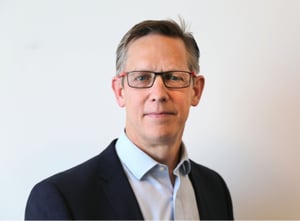




Andy Start spent four years as Chief Executive of Defence Equipment Support, procuring military equipment for the UK MOD and serving as the UK's National Armaments Director. Before that, he spent more than two decades as a chief executive driving strategic change across technology, aerospace, and space businesses.
In this episode, Andy joins Craig Spence to explore what separates organisations that achieve real transformation from those that change the surface and call it done. Drawing on eight major programmes, he makes the case for designing operating models around technology rather than protecting the structures that predate it, examines what AI-led transformation actually looks like in practice, and explains why the emotional and organisational complexity of change means external expertise is not a luxury but a prerequisite.

Key takeaways
- Start with strategy, then the operating model, then the technology. Leading with the tool imports a business model you never chose.
- Adopting software, and especially AI, means asking which processes no longer need a human structure at all, which reshapes the organisation.
- The hardest part of transformation is human: roles shrink or change, so leaders need independent help that sits outside the politics and emotion.
- Most organisations currently bolt AI onto existing structures. The few that put AI at the centre of the change achieve the largest gains.
- Transformation is a specialist skill. Organisations must lead it from within, but need external expertise to do it well.
Andy Start's background
Craig Spence: Andy, great to have you with us, thank you for joining us. Over your career you've led eight major transformations, in both the public and private sectors. Could you introduce yourself and share a few thoughts on what you've learned about change at scale?
Andy Start: Thanks for inviting me, Craig, it's a real pleasure. I've been lucky to have a diverse career, mostly running technology, aerospace, and space businesses, and for the last 25 years or so as a chief executive driving a lot of strategic change and transformation. For the last four years I've worked in the public sector as Chief Executive of Defence Equipment and Support, buying all of the military equipment for the UK MOD, and as the UK's National Armaments Director. That gave me the chance to see what is really different about transformation in the public sector versus the private sector.
Why starting with the technology leads leaders astray
Craig Spence: Thinking about technology-driven change, at DE&S you led a major digital transformation. When leaders start with the technology, where does that instinct lead them astray?
Andy Start: I first learned the impact of technology running a company called IFS, an ERP company. We did ERP implementations for hundreds of companies across aerospace, defence, and manufacturing. The ones that got it right recognised that adopting any technology, and software in particular, means importing a business model that is embedded in the code. That is challenging for the way leaders think, because if you take an operating model out of a piece of software, you are subordinating your structure, and your choice of who does what, to the software. For senior stakeholders that can mean a department no longer needs to exist the way it does today, so someone's job changes completely, and that is deeply uncomfortable from a people perspective. The technology creates a whole set of people problems. But if you put the wish to keep structures the same ahead of the technology, you build in enormous inefficiency.
Why AI raises the stakes on operating-model design
Andy Start: The same is true today when we implement AI. As you go through any change or transformation programme, you need to start with a very clear external strategy: what does my organisation need to do, how much faster, cheaper, better, and more competitive, and what new capabilities does it need? You then align your operating model to that strategy. But if you are adopting software, and particularly AI, when you reach the process part of operating-model change you have to ask whether that process can be done by AI instead of people. If it can, you strip it out of your structures, because you do not need a structure to deliver something software can do. You end up with a completely different shaped organisation from the one you would have without AI.
The human and emotional side of change
Andy Start: That is genuinely tough from a human perspective. You are effectively telling your senior leaders that their boundary used to be here, and now it is here. You only need the people doing the genuinely cognitive work, or the real hands-on work, the parts where empathy and human presence matter rather than transaction. A leader who ran a large department with many people might afterwards run a much smaller one, doing quite different things. That is a big emotional journey. If your audience is wondering why they would talk to consultants about this, it is because I firmly believe you cannot execute these kinds of changes without external help. You need people who are independent from the politics, the hierarchy, and the emotion of the change to allow you to make it.
Are leaders doing the hard thinking, or bolting AI on?
Craig Spence: Given the size of the challenge and the emotional journey leaders have to go on, and with AI as the biggest driver of the day, are you seeing leaders do that underpinning work, or are more of them bolting it on to what they already have?
Andy Start: The vast majority of AI implementation right now is in the latter camp: I'm rolling out Copilot, let's see what it can do. AI is changing so quickly that this is not actually a bad starting point, because it opens up people's thinking. There are a few places, and in my last organisation we did this only in small pockets, where we genuinely put AI at the centre of what we were doing and built it into the transformational change. Where people have done that, they are achieving extraordinary outcomes, extraordinary leaps. But it is difficult.
The biggest lesson: transformation is a specialist skill
Craig Spence: Looking back across all the transformations you've led or been part of, if you could tell your earlier self one major lesson, what would it be?
Andy Start: The Chief Executive of BAE Systems once leaned into me and said, "If you want to drive strategic change, get the right help." The most significant lesson is that transformation is a specialist skill. Organisations have to lead it from within, but you have to have specialists to help you if you are going to do it well.