



Skip to content
A zoomed out shot of people walking near the water

Functions of the Future

A New Architecture

Your organization was architected for a world that rewarded stability. That world is gone, and the architecture is now the obstacle.

The Old Architecture

25% of production time lost to coordination overhead
32% of potential performance improvement blocked by governance
70% of budgets consumed by keeping the lights on
80% of firms report no AI-driven productivity gains

Three hidden taxes on your AI strategy

Most organizations have already tried the obvious fixes. A new structure. A new strategy. An agile team here, an innovation lab there. It might work at the jump, but then the same friction returns—the same slow decisions, the same senior people buried in operational work, the same initiatives that never quite get the resources they need.

That's not a people problem or an AI problem. It's an architecture problem. Your organization is running on a structure built for a world that rewarded stability. That world is gone. And every new initiative (AI included) gets taxed by it: coordination overhead that consumes a quarter of productive time, governance layers that block the calculated bets that drive growth, maintenance burden that traps your best people in keeping the lights on.

Reorganizing doesn't fix this. Neither does deploying more technology. Both run inside the same broken premise.

This series diagnoses why the architecture is failing, why AI accelerates the problem, and what it looks like when you start to fix it.

The Three Taxes

Friction Tax Your people spend more time coordinating work than doing it. Every decision requires alignment. Every initiative requires negotiation.  
Governance Tax Caution calibrated for the highest-stakes decisions gets applied to all of them. Layers of review accumulate. No one removes them.   
Maintenance Tax Your most experienced people are trapped keeping systems running. Strategic initiatives sit perpetually delayed — starved of the capacity they need.  

Three Perspectives, One New Architecture

Key Questions Answered

Why do organizational redesigns fail to move the needle? Every past reorganization changed which work went where. It didn't change the premise that all work should be governed, staffed, and measured the same way. That's the difference between a reorganization and a redesign.
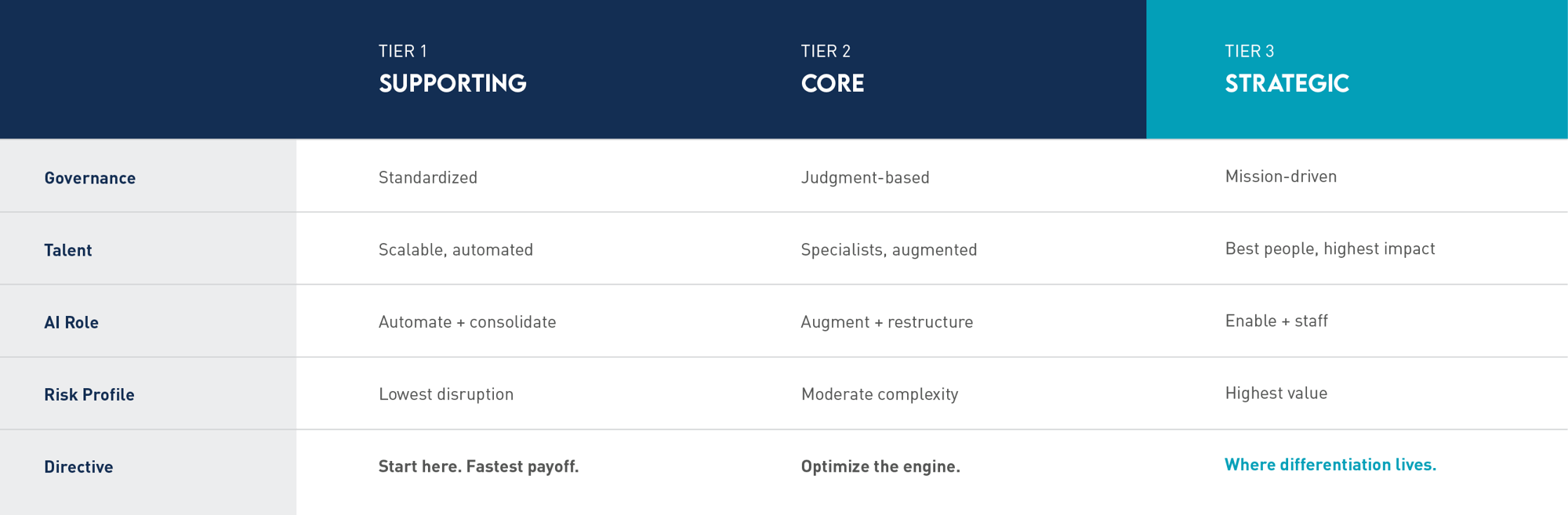
What does a redesigned operating model actually look like? Three tiers of work—supporting, core, and strategic—each with its own structure, governance, incentives, and AI relationship. Supporting work automates. Core operations standardize. Strategic work mobilizes. One structure can't optimize all three.
What makes this architecture hold up over time? It’s a flexible operating model, designed for motion. When the work shifts, you reclassify. The communities endure. The missions evolve. The coordination adapts. Cleveland Clinic made a similar structural distinction in 2008; and the model has compounded for 18 years.
How does AI change the equation? Past disruptions changed tools and infrastructure. AI changes the work itself. Every role, every function will be AI-enabled. The organizations getting this right are addressing talent and technology as a single system, not separate workstreams.
Where do you start this kind of redesign and how does the change fund itself? Start with supporting work: furthest from leadership identity, lowest cost, fastest payoff. Each tier you address funds the next. An 80-person department that reclassifies and automates 35% of supporting work can redeploy 15 people and generate $1.5–2.5M in annualized savings or redeployment value.
Can a single leader drive organizational change without enterprise buy-in? Yes. Classify your team's work into three tiers. Map who is doing what. Identify the mismatches. The classification exercise alone changes the conversation. You don't need enterprise sponsorship to start you need it to scale.

Want to Connect?