




How North Highland helped a state public health agency build a financially sustainable laboratory system, from initial assessment through operational transformation.
The Situation
A decade of drift between pricing and reality
Public health laboratories do work that cannot be paused or outsourced without consequence. They test for disease outbreaks, support emergency response, and deliver services that state and local health departments depend on daily. But doing that work sustainably requires sound financial management, clear service priorities, and operational infrastructure that can hold up over time.
A state public health agency faced a growing gap between those two realities. Its laboratory fee structure had gone unchanged for more than a decade, leaving pricing disconnected from actual service delivery costs. That misalignment made it harder to reinvest in modernization, align resources with evolving public health priorities, or make strategic use of available federal and state funding. The agency needed a clear-eyed view of where its lab operations stood, and a credible path toward long-term sustainability.
Our Approach
Two phases, one continuous arc of improvement
North Highland supported the agency across two phases of work, bringing together financial expertise, operational analysis, and strategic planning to address the challenge from multiple angles.
In Phase 1, the team conducted a comprehensive assessment of operations across multiple state Public Health Laboratories, evaluating service demand, performance metrics, and fee structures, and benchmarking against peer labs to identify where agency stood relative to comparable organizations. The result was a data-driven foundation for decision-making, including a roadmap that clarified which services should be kept in-house, when to explore outsourcing, and where operational improvements would deliver the greatest impact.
Phase 2 addressed the financial systems and decision-making infrastructure that determine whether improvements hold over time. North Highland developed four interconnected workstreams, each translated into practical tools the agency could use independently after the engagement ended.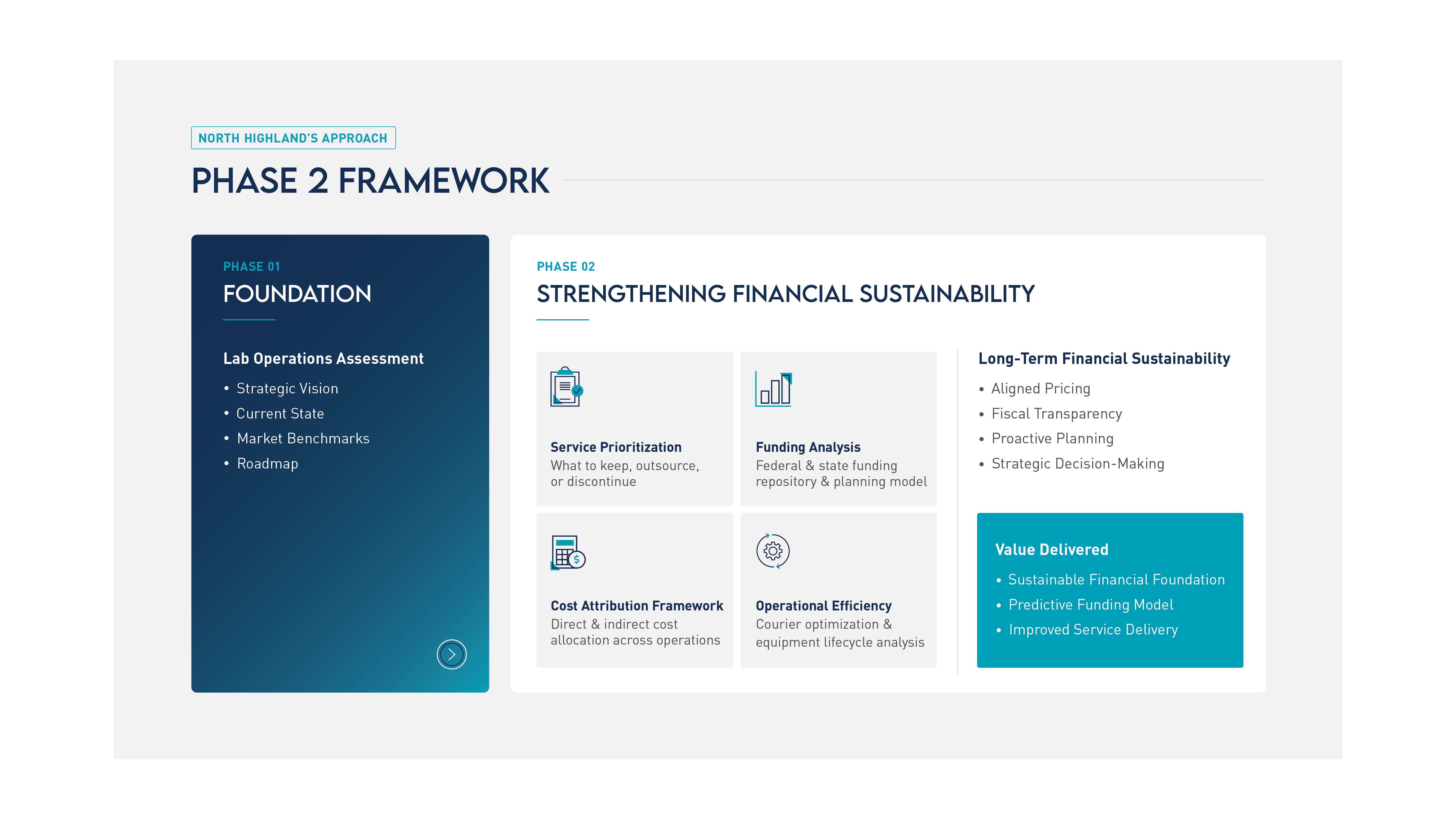 Together, these workstreams gave the agency significantly sharper visibility into its costs, its funding, and its service priorities across laboratory operations statewide.
Value Delivered
From financial pressure to operational confidence
Across both phases, the work gave the agency the tools, data, and strategic clarity to run its laboratory system on sustainable financial footing. Fee structures were brought into alignment with actual costs and market conditions, while a predictive funding model enabled the agency to anticipate funding gaps and optimize drawdowns rather than react to shortfalls. The engagement strengthened pricing alignment, improved cost and funding transparency, enabled more proactive financial planning, and gave leadership a clearer framework for service prioritization across laboratory operations statewide.
-
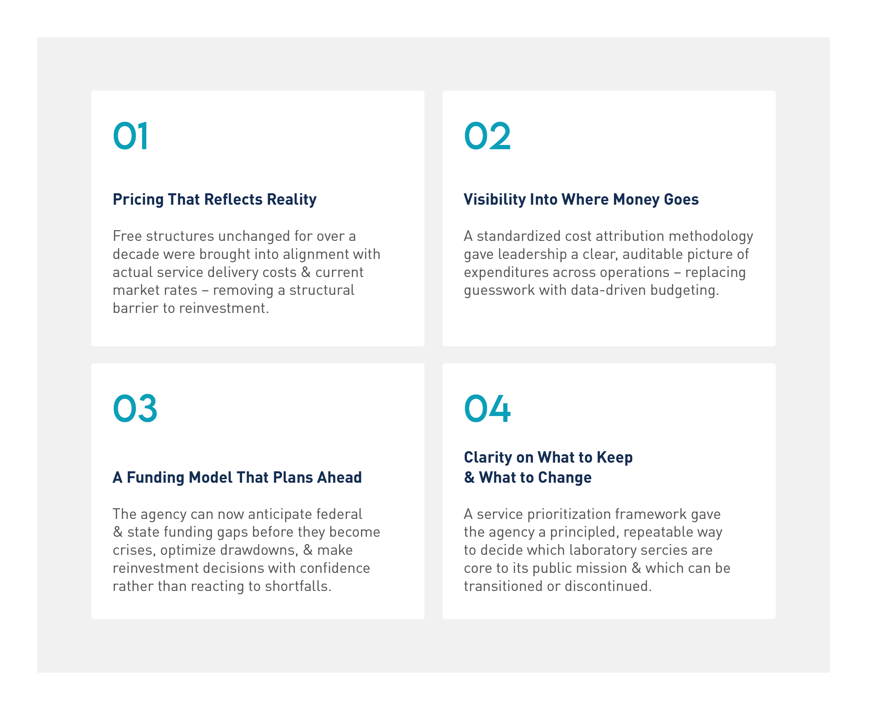
Pricing that reflects reality. Fee structures unchanged for over a decade were brought into alignment with actual service delivery costs and current market rates, strengthening cost recovery, and expanding the lab's capacity to fund ongoing operations and improvements.
-
Visibility into where money goes. A standardized cost attribution methodology gave leadership a clear, auditable picture of expenditures across operations, replacing guesswork with data-driven budgeting.
-
A funding model that plans ahead. The agency can now anticipate federal and state funding gaps before they become crises, optimize drawdowns, and approach funding allocation and oversight with greater confidence and strategic intent.
-
Clarity on what to keep and what to change. A service prioritization framework gave the Public Health agency a principled, repeatable way to decide which laboratory services are core to its public health mission and which can be transitioned or discontinued.
 This engagement is a demonstration of what sets North Highland apart: the ability to combine deep public sector knowledge with analytical tools and implementation discipline. No assessment stays relevant if it sits on a shelf. What the agency gained was not just a roadmap. It was the financial infrastructure and decision-making capability to follow it.
Ready to strengthen your public health lab's financial and operational foundation? Let's talk about what's possible.