



The last three years have seen a plethora of lectures, articles, and discussions exploring what lessons the UK Ministry of Defence (MoD) can learn from the conflict in Ukraine. Has the use of unmanned aerial systems (UAS) fundamentally changed the character of conflict? How do we iterate capabilities on the battlefield? Does the UK have a sufficiently robust electronic warfare capability?
Yet these tactical and operational questions represent only the tip of the iceberg for an organisation in the midst of profound transformation, both digital and structural. Through initiatives such as Defence Reform, the Ministry is rethinking how it organises, equips, and sustains the force for the challenges of the next decade.
When it comes to lessons on digital and organisational transformation, however, the best examples often lie outside the public sector. Industries such as financial services, retail, and life sciences have spent the past decade adapting to seismic market shifts, integrating digital systems, reconfiguring supply chains, and evolving their workforce models, all while maintaining a high operational tempo.
In a series of short upcoming articles, we'll equip you with insights on what Defence can learn from these sectors: how they've managed continuous change, built resilience into their operations, and sustained high performance amid constant disruption. Our aim is to identify practical insights that can help Defence not only transform, but thrive in the information age.
Let's be honest - defence transformation is hard. Really hard. The stakes are higher than in any commercial sector. Failure isn't measured in profit margins but in operational readiness and, ultimately, lives. That's precisely why looking outside the defence bubble matters.
Today, we're sharing three key lessons from our work in Life Sciences—a sector that, like Defence, operates in highly regulated environments with complex supply chains and where reliability is non-negotiable.
1. Speed + Structure = Decisive Advantage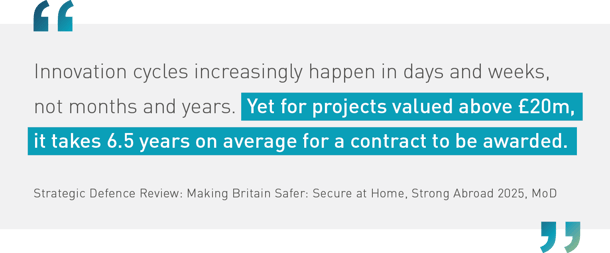
In a world where the pace of change is accelerating, both speed and standardisation are becoming decisive advantages.
When we helped a global pharma client cut regulatory submission timelines from 24 weeks to just 8 weeks, they didn't just save money - they secured market rights and first-mover advantage worth millions.
For the MoD, agility in adopting new technologies, responding to emerging threats, and adjusting force posture is equally vital. Yet - speed without structure risks chaos.
The transformation we've seen in cell and gene therapy, where development cycles shrank from eight years to one, wasn't achieved through shortcuts. It came from rethinking operations around scalable, standardised frameworks rather than bespoke, one-off solutions.
What this means for Defence:
- Benchmark delivery timelines for critical capabilities and ruthlessly drive down bottlenecks
- Establish "rapid response" pathways with lighter governance and fast-track approvals
- Identify and standardise common capabilities (logistics, cyber assurance, data analytics)
- Build repeatable, scalable models that enable faster, leaner decision-making
2. Integration Unlocks Transformation
Defence transformation will only achieve lasting impact when the MoD can move from fragmented, manual legacy systems to real-time, integrated operations and crucially, build the internal capability to sustain that transformation itself.
The challenge looks familiar: One of our life sciences clients was struggling with 15+ disconnected legacy systems and a submission process bogged down by 60% manual document handling. Sound like any defence procurement processes you know?
We didn't just implement new technology. We mapped end-to-end processes, identified integration points, and built a digital backbone that connected previously siloed systems. The result? Not just speed, but quality improvements, cost reduction, and better decision-making.
The parallel for Defence is clear: stovepiped IT, paper-heavy workflows, and disconnected data flows across procurement, logistics, and readiness reporting slow decision-making and reduce agility.
What works:
- Map end-to-mission processes before selecting technology solutions
- Break down data silos to create a single source of truth
- Build an integrated digital backbone where information flows seamlessly
- Support decisions with near real-time data
Yet technology alone isn't enough. As we've seen with a leading Pharma client’s "Learn then Lead" model, sustainable transformation depends on internal ownership. When we paired their internal staff with our experts in apprenticeship-style programmes, they didn't just implement change. They owned it.
Similarly, in working with another life sciences client, we’ve seen demonstrable success creating AI pioneer communities that expedite the adoption of AI tooling. These cross functional ‘AI Expedition Pods’ saw thousands of employees sign up to become ‘AI Pioneers’. Having benefited from learning events and a tailored recognition scheme, these employees delivered increased productivity, improved innovation and secured early adoption advantage for their organisation.
The MoD must cultivate its own transformation leaders in this way, embedding capability transfer from day one. This isn't about replacing external expertise but creating a partnership that builds lasting internal capability.
3. People, Process, Technology: Move All Three Together
True transformation happens when structure, technology, and people evolve together. This might sound obvious, but we've seen countless programmes falter when these elements move at different speeds. 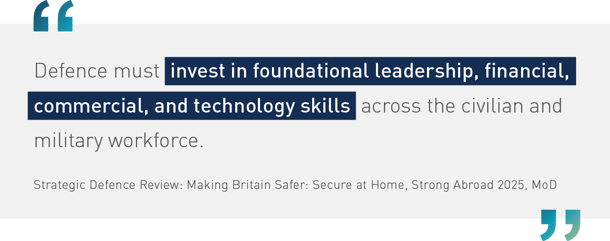
In our work with a leading biotech firm, success came not just from implementing digital tools but from simultaneously:
- Redesigning governance and decision rights
- Upskilling teams in digital capabilities
- Reshaping culture to embrace continuous improvement
For the MoD, the same principle applies. Too often, we see new technology adopted, but without the appropriate training or required process redesign. The result? Limited impact and, frequently, reversion to old ways of working.
Breaking the cycle requires:
- Mapping your future digital operating model
- Assessing workforce gaps in key areas like data analytics, cyber, and change leadership
- Embedding continuous talent development and reskilling
- Treating change management as mission-critical, not an afterthought
Defence organisations with strong traditions and hierarchies face unique cultural challenges. At North Highland, we've pioneered a 'parallel transformation' approach that addresses technology, process, and culture simultaneously - enabling our defence clients to achieve the same accelerated outcomes we've delivered in life sciences.
What's Next?
For the MoD's transformation journey (whether digital, organisational, capability-based or workforce-oriented), the life sciences domain offers rich parallels: highly regulated, high-stakes, complex supply chains, long time-horizons, and a strong requirement for both speed and reliability.
In our next article, we'll explore lessons from financial services - particularly how leading institutions have balanced innovation with security and compliance in their digital transformation journeys.
Ready to accelerate your defence transformation? Schedule a no-obligation conversation with our defence specialists to discuss your specific challenges – just hit the Lets Talk button below.