




Why Projects Struggle in a Fast-Moving World
Organizations are struggling to keep up with rapidly changing market conditions. They face long lead times, slow responses to customer needs, and siloed teams that deliver outputs, not outcomes. This is largely due to the pursuit of traditional project-led delivery which struggles with flexing and adapting to the world evolving around it. It’s frequently cited that around 70% of projects fail to deliver what was promised and this is because traditional structures often lead to:
- Slow response to market changes and delayed customer value due to fixed scopes, upfront commitments, and funding models that reward plan certainty over learning and adaptation.
- Friction between business and tech teams due to projects optimizing for delivery milestones rather than shared outcomes, leaving technology teams accountable for execution but disconnected from strategic intent.
- Inability to identify misaligned or failing investments due to one-off business cases, centralized approval cycles, and siloed teams that obscure real value until long after money has been spent.
But there's a better way—a proven alternative that's reshaping how forward-thinking organizations operate.
From Stability to Speed: The Product Advantage
Shifting to product-based models creates a direct path to faster value delivery and stronger market responsiveness. These models align teams, funding, and decisions around enduring outcomes rather than temporary initiatives.
By funding long-lived products instead of short-term projects, organizations build stable, accountable teams with a sustained stake in what they deliver and maintain. This consistency reduces context switching, strengthens ownership and, as a result, has been shown to improve team throughput by up to 17%.
Another byproduct of improved stability and accountability: faster and more reliable speed-to-market. Teams working in product models can launch features 2.4 times more frequently, moving from idea to implementation with fewer handoffs, clearer ownership, and tighter customer feedback loops.
These benefits extend beyond individual teams. Well-implemented product models allow organizations to respond to emerging pressures in real time. They strengthen alignment across the enterprise, bringing finance, marketing, technology, and operations into a shared value conversation. And they enable portfolio-level, value-based decision making, helping leaders redirect investment earlier and focus resources where they deliver the most impact.
To put it simply: Product models work because they align stability, speed, and decision-making around value and customer outcomes.
The Project-to-Product Journey Is Worth It. But It’s Not Easy
Many product transformations stall or fail. According to a recent report from Digital.ai, only 52% of survey respondents believed their enterprise product practices worked effectively.
This failure often stems from a lack of overall clarity that inhibits their approach and ability to assess which changes to people, processes, technology, and culture they should be targeting and in what order.
This usually shows up as:
- Siloed thinking between technology and business areas that limits collaboration and scaling across business units; 37% of organizations cited business area lack of understanding.
- Valuing processes over culture and ineffective training of talent; engagement decreased 27% in organizations overfocussing on process metrics.
- Emphasis on tactical or blanket decision making instead of taking a long-term, strategic view; according to 42% of organizations surveyed.
- Lack of executive alignment and involvement in setting strategic direction and making rolling decisions, only 40% of organizations cited involved executives.
An Effective Approach Turns Intent into Impact
The most effective transitions start small, with a limited number of products and value streams, and scale deliberately as confidence, capability, and evidence build.
That requires aggressive and ongoing prioritization. Rather than spreading effort thinly across multiple areas, successful organizations focus relentlessly on the changes that unlock the most value, revisiting priorities as learning emerges. This ensures attention stays on outcomes that matter, not activity that simply feels busy.
There is no single blueprint for doing this well. Product operating models must be shaped to fit an organization’s culture, business model, and level of product maturity. What works for a digital-native start-up will look very different from what works in a regulated enterprise, both can still be right.
From years of partnering with companies on product transformations, here are seven keys that significantly increase the likelihood of success:
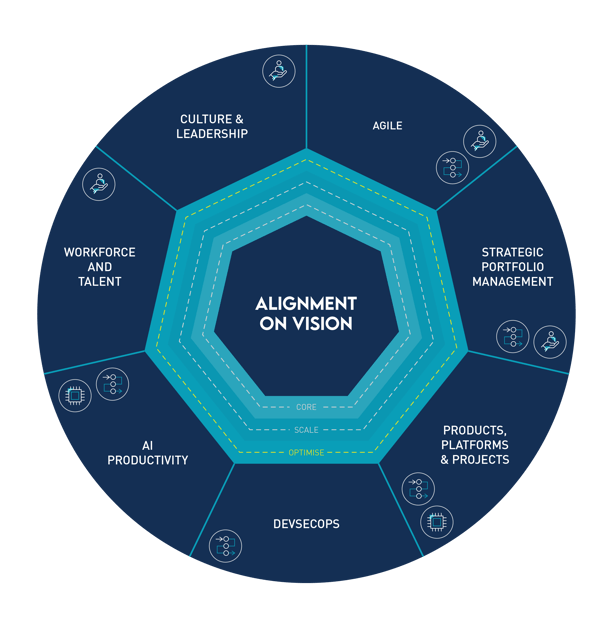
Making Your Transformation Stick
The benefits of transforming into a product-based model are plentiful, but the shift in organizational mindset is critical.
You need to consider:
A holistic view of your organization, your people, and the maturity level of each of the dimensions outlined in this article. From there, you can decide priorities and identify quick wins to build momentum. Lasting impact doesn’t come from overnight success. Sustainable, continuous progress is what will deliver meaningful changes for your people, your customers, and your company.
Interested in learning more about what a product-mindset can do for your organization? Reach out to our team to speak about our approach and expertise with project-to-product transformations.